Some of you have already discovered Down with Downtime: K-5 Reading has been available in my Teachers Pay Teachers Store for about a week even though I never blogged about it. And now Down with Downtime: K-5 Language Arts is also ready so I thought I'd let you know about both. Like Down with Downtime: K-5 Math, these two packets are for those minutes after a lesson is finished, but it's not time for the next activity. All Down with Downtimes are based on the Common Core State Standards and incorporate as many Higher Order Thinking Skills as possible. Remember, they are good for grades K-5, although not every activity will be appropriate for every grade level. You must use your discretion in choosing the right time filler.
There are free samples for both as well. Either download the preview for each at Teachers Pay Teachers or get them by clicking here:
FREE Down with Downtime: K-5 Reading Sample
Monday I subbed in a fourth grade class. The teacher had told me ahead of time that she was so sick she would not have time to put together lesson plans. I was familiar with the other teachers on the team and the class, however, and knew the teachers would provide me with everything I needed and the students would hang right there with me while we figured it out. Just in case, I brought a Compare and Contrast activity using three picture books.
For Christmas, I asked for any books by Patricia Polacco as she is one of my favorite authors. Yes, I am a grown-up, but when you teach elementary students, you ask for picture books. What I got was a title I was unfamiliar with, but now love... Bun Bun Button. When I read it, I was immediately reminded of Knuffle Bunny by Mo Willems and Corduroy by Don Freeman since they all tell stories of special loveys treasured by children. I already had the other books, so I brought all three.
Sure enough, we had time (and the students begged me) to read all three books. And amazingly, the reading skill they were focusing on for the week was compare and contrast! Perfect! When we finished all three, I had the students draw and complete a Venn diagram comparing and contrasting the three books. The students went to town. They are great books to do that with! Each pair of books has unique things in common, all three have things in common, and each book has differences as well... plenty to fill in each spot in the diagram. I just had these students draw their Venn diagrams on a sheet of notebook paper, but I have created a freebie for you. Compare and Contrast Loveys has four Venn diagrams, three with the various combinations of two of the three books to use with younger students, and one with all three for the older ones.
These would be great sheets to laminate to reuse with multiple classes, or as an alternative to lamination, you can simply put them in a sheet protector and it serves as make-shift lamination.
As an extension for earlier finishers, I had them write on the back of their diagram a connection they were able to make with the book. Many wrote about their own loveys, but one student even related the stories to Linus from the Peanuts comic series. We did this activity in the morning, and they were still talking about it at dismissal. I would say it was a success!
And if you need a source for the books, I have provided the Amazon links in a slideshow below.
As I was writing the third grade Just Add Water emergency sub plans, I had an idea... to make a simple story map that doesn't need to be copied AND doesn't require the students to draw anything (because often that is messy and unreadable). My idea was to fold a piece of paper into four sections, and label the sections Characters, Setting, Problem, and Solution. It can be used to show comprehension of a reading story or as a planning organizer in the pre-write stage of the writing process. I have dubbed my creation the 4-Square Story Map.
This week my third graders were working on fact and opinion. Since that is always a hard skill for them to grasp, I tried several ways of teaching it. First, we hit the basics: "a fact can be proven" and "opinion is a thought or a feeling." Then we looked at many examples and created a list of clues to help point them in the fact or opinion direction. I used those clues to create an anchor chart that we added to throughout the week (that's why it's in several different colors and not the neatest anchor chart ever). I did make sure they knew that these words were just clues. Here is the anchor chart we created together:
Each day we practiced the skill in a new way. One day I had them make a T-chart for facts and opinions they found in the story for the week. Another day I used a worksheet that listed statements, and students labeled them fact or opinion and then had to circle the words that told them whether it was a fact or an opinion. My favorite day was the day I gave each pair of students an ad from a magazine. The students had to look at the ads and decide which statements were facts and which were opinions. I particularly like this one because it also helps them read advertising with a critical eye.
I believe this helped my students have a better understanding of fact and opinion (just my opinion, of course). :-)
And to launch into the holiday season, I have created a Winter Holiday Fact and Opinion activity sheet. And that's a fact. :-)
This week my third graders were focusing on main idea as their reading skill. Here are a couple of highlights from teaching the concept. First, we talked about how main idea is what the story is mostly about, and I created this anchor chart comparing main idea to a roof. Just like you have to have pillars to hold up a roof, you also have to have details to hold up a main idea. If you can find only one or two details to hold up what you think is the main idea, then it's probably not the main idea.
The next high point came in using an idea I saw on Pinterest. Students traced their hand on a piece of construction paper. I had them choose a page in the reading story for the week and write the main idea on the palm. Then details went on each finger. Again, I emphasized that we need all of our fingers so they needed to find that many details or the hand wouldn't work. Here are a couple of examples of the hands.
It seemed to be a more creative and practical way of reinforcing the concept of main idea.
Finally, now my first set of elementary level emergency sub plans is complete! And just in time for cold and flu season. I just put the finishing touches on fifth grade plans based on the book Stellaluna by Janell Cannon. I know fifth grade teachers have differing opinions on the value of teaching through picture books. Many feel students at this age should be reading and analyzing higher level books.
However, my thinking here is twofold:
1) Practically speaking, these plans are meant to be completed in one day while a substitute teacher is in the room. A higher level chapter book cannot even be read in one school day, much less have time to complete activities.
2) Philosophically speaking, I am on the other side of the debate. I am an adult and still many times get much out of picture books. Fifth graders can take picture book analysis to a much higher level. So while, many students may already know the story in the picture book, they have not done such challenging activities with it.
All that being said, here are the fifth grade plans based on Stellaluna. As with my other plans, these contain a warm-up, a reading lesson, a language arts activity, a social studies lesson, a science activity, and some math problems.
OK, kindergarten subs and teachers. Ready... set... DOWNLOAD!!! Here are some emergency kindergarten sub plans for you. These are based on If You Give a Mouse a Cookie and include a craft warm-up, a reading lesson, a language arts lesson, a social studies lesson, a science lesson, and a math lesson.
I have to say these have been the hardest ones so far for me to write because of all the things I needed to create. So, hats off to all you kinder teachers!
My husband was just telling me, "I like how all your plans are based around a theme. I don't think it would be good to theme teach every day, but it's nice to have something different when a sub is there." That is basically my purpose in theme-planning the lessons. And I also try to use as few materials as possible because a sub never knows what will be available when they walk into a classroom. Anyway, I hope these plans help even just a few teachers and subs. Enjoy!
One of my favorite higher order thinking skills to work on is seeing things from another perspective. I got this idea from my children's gifted and talented teacher Wendy Brake, and I adapted it for use in a regular classroom. Before the first perspective activity we do, I have students make "perspectacles." When worn, these glasses allow students to see an event from someone else's perspective.
I give each student five chenille sticks, two for the eyes and two for the ear pieces and one to cut up for decoration. The student then twist them together to form a pair of glasses, using extra pieces to decorate. I've had students add eyelashes, a moustache, and all sorts of details. It's fun to see their creativity and personality come through.
The perspectacles live in the students' cubbies throughout the year, and every time we do a lesson or activity using perspective, the students are allowed to wear their glasses. The students ask me almost every day if we will be doing something with perspective because they just love to wear the glasses.
I am so sorry it has taken me so long to get these going, and I promise the wait will not be as long for the fourth grade set. Getting settled into my long-term subbing position has been challenging, but I think I am falling into a nice routine.
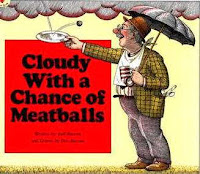
Here are my third grade emergency sub plans. I based them on Cloudy with a Chance of Meatballs by Judi Barrett. Just like the other sets of plans, these have a warm-up, reading, language arts, social studies, science, and math lesson. Although intended to be used as one day's worth of lessons for third grade, they can be used on their own or modified for other grade levels.
What an amazingly long week this has been! Thank goodness tomorrow is Friday... and early release for my district. I wanted to share a reading lesson that worked really well for me today with my third graders. All week long we have been working on drawing conclusion, making inferences and making predictions as well as being able to figure things out about a character. So I modified a lesson that I had heard about being used for writing.
First I wrote four "signatures" on the board. Then I asked the students to look at the signatures and use what they already know to draw conclusions, make inferences, and make predictions about who these characters are. I asked for three ideas about each character, and then they could draw what they thought one character looked like.
I got some great responses like Sandy being a girly girl, pretty, and friendly. I also had some students who concluded she was popular, stuck-up, and mean. I was able to point out that because of knowledge we already have, sometimes our conclusions are different even if we have the same clues.
The students were able to predict age of the characters and even infer some interests. Most concluded that Sandy and Rex were somewhere between 10 and 15; Mary was a grown-up; and David was a child. And many thought Rex was into dinosaurs because of his name and the Jurassic Park-like font I used.
It was a really fun activity that brought home using clues and your own knowledge to draw conclusions, make inferences, and make predictions.